Are we there yet?
Children's television has a lasting influence
Hilary Porado
5/12/20261 min read
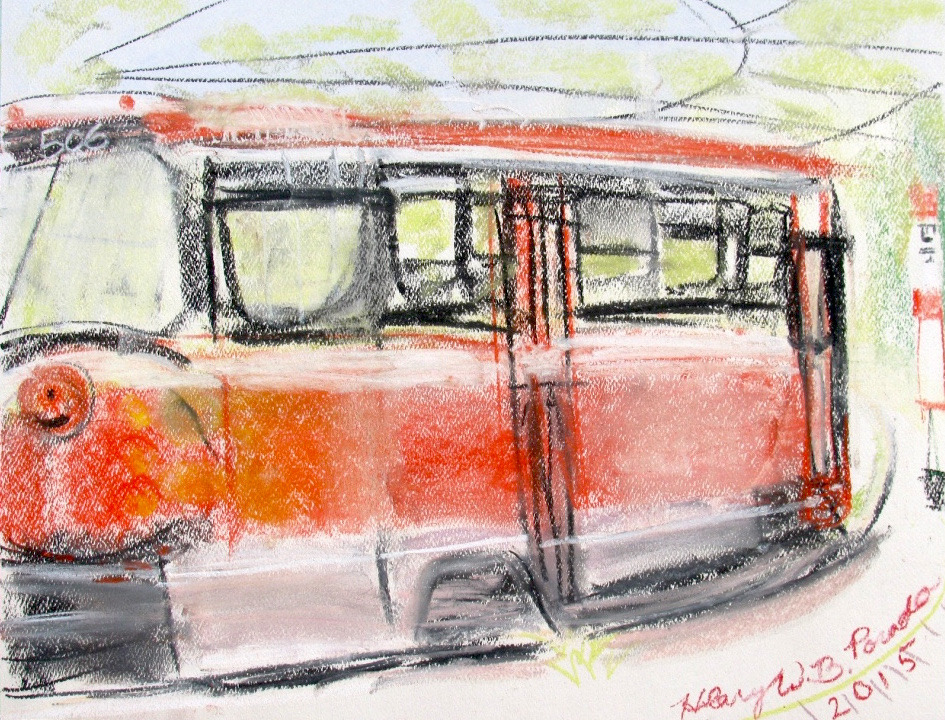
Mother insisted we watch Mister Rogers Neighborhood when I was a child in New York City. Trolley was the coolest part of the show. It went to the Neighborhood of Make Believe.
Years later, my husband Phil was a big fan of a trolley museum in Maryland and liked to take the family on rides around a grassy field on old trolleys. Then we emigrated to Toronto, Canada where trolleys are very much a part of life.
Phil suggested I paint the Toronto trolleys. I painted a trolley in High Park with fall foliage. It was shown at a solo exhibit at Runnymede Library and sold at a school fundraiser. Trolleys became a series. Over the years, trolleys appeared in many works. So did Go Trains, cars, trucks, busses, airplanes, boats and bicycles.
Moving models were de rigueur in Professor Rayen's Drawing class at Wellesley College where I went to school. Moreover, painting students were encouraged to paint moving objects. One remembers holding a hammer in her left hand and moving it whilst painting with her right hand.
In school, we did not paint moving people or animals. That is a new thing that one started to do in Toronto. The trolley pastel above is really many trolleys that would arrive at a loop and stop briefly and then travel on. The image was printed on note cards and sold in stores.
In 2022 one read that Misterogers was, in fact, a show in Toronto from 1961-64 on CBC-TV and that the assistant puppeteer became Mr. Dressup, Canada’s beloved children’s show star. What’s more, the CBC producer Fred Rainsberry had a big influence on Fred Roger’s career, convincing him to come out from behind the puppet theatre and interact with children on the show. Mr. Rogers already had had a show in Pennsylvania, but he put the trolley in for the Toronto market. It reminded him of his own childhood when Pittsburgh still had trolleys.
Swan and Trolley; Swan, Trolley and Photographers; Morning on the Queensway; 506 Trolley; and Trolley in the Snow are some notable works.
© 2026 All rights reserved.
